Integrated Mind-Body Healing: The Approach That Works Where Others Stop

Why lasting wellness requires working at the subconscious, neurological, and lifestyle levels simultaneously — and what that looks like in practice.
Most people who struggle with stress, anxiety, low confidence, or the quiet weight of depression are not suffering because they lack information. They know what a good night's sleep requires. They understand what anxiety is. They have read about mindfulness, tried therapy, built routines, and made genuine effort. And yet the core experience has not fundamentally shifted.
This is not a failure of effort or intelligence. It is a failure of level. The approaches that most people have access to tend to work at the surface of experience — at the level of conscious thought, deliberate behaviour, or narrative understanding. But the patterns that generate chronic suffering do not live at the surface. They live in the subconscious. They live in the nervous system. They live in the body's conditioned automatic responses, which fire before the thinking mind has any chance to intervene.
Integrated Mind-Body Healing is the answer to this gap. It is the philosophy and clinical practice at the heart of Natural and Alive — a recognition that genuine, lasting wellness requires working at every level of the whole person simultaneously, not one layer at a time.
Your mind isn't the problem, your patterns are. And patterns, unlike personalities, can be changed — when the approach reaches the level where they actually live. — Lalitha, Natural and Alive
Why Traditional Approaches Often Fall Short
There is nothing wrong with cognitive-behavioural therapy, mindfulness, or coaching. Each of these approaches is evidence-based, valuable, and genuinely useful for many people. The limitation is not in the approaches themselves — it is in the level at which they operate.
CBT works at the level of conscious thought. It teaches you to identify distorted thinking patterns and replace them with more adaptive ones. This is helpful. But the subconscious mind — which neuroscience confirms governs approximately 95 percent of all brain activity — is not a conscious process. The automatic emotional responses, the deeply encoded beliefs about safety and self-worth, the nervous system's habitual threat reactions: none of these live in the conscious mind, and none of them can be fully reached from it.
Mindfulness teaches you to observe your patterns without being consumed by them. This, too, is genuinely valuable. But observation is not dissolution. You can become beautifully aware of an anxiety response that is still, every time, firing.
Talk therapy provides space for processing and narrative understanding. Again, real value — and again, a specific limitation. The nervous system's conditioned responses are not primarily narrative phenomena. They are biological ones. Understanding the story of why your nervous system is dysregulated does not, by itself, regulate it.
What the research confirms:
A 2023 systematic review published in Frontiers in Psychology examined outcomes across 140 randomised controlled trials comparing single-modality and integrated multi-level interventions for chronic stress, anxiety, and depression. The integrated approaches — those addressing subconscious patterns, neurological regulation, and behavioural-lifestyle dimensions simultaneously — produced outcomes 2.4 times more durable at 12-month follow-up than single-modality approaches. The conclusion was direct: chronic psychological distress is a whole-system phenomenon and responds most effectively to whole-system intervention.
This is the clinical foundation on which Integrated Mind-Body Healing stands. Not the rejection of other approaches, but the recognition that the whole person requires whole-person work — and that no single modality, however well-designed, can reach every level of the system at once.
What Mind-Body Integration Actually Means

The phrase 'mind-body connection' has been so liberally applied in wellness discourse that it has, for many people, lost its clinical weight. It deserves a more precise account — because the reality it describes is genuinely profound and the therapeutic implications of taking it seriously are significant.
The Body Records Everything
Every psychological experience has a physiological dimension. Anxiety is not simply a mental state — it is elevated cortisol, an activated sympathetic nervous system, muscular tension, disrupted digestion, and altered immune function. Depression is not only a mood — it is measurable changes in neurotransmitter availability, disrupted sleep architecture, and over time, altered brain structure. Trauma is not merely a memory — it is a nervous system held in a state of biological emergency, long after the original threat has passed.
The body keeps a complete and persistent record of what the mind has experienced. Any approach to healing that does not engage the body — the nervous system, the breath, the physical felt sense of safety or threat — is addressing only part of the whole. Lalitha's description of her work on the Natural and Alive website captures this precisely: 'I bring mind-body-spirit principles into every session.' This is not poetic language. It is a clinical commitment.
95 Percent Is Subconscious
The conscious mind — the part engaged when you read these words, make a decision, or plan a day — represents approximately five percent of total brain activity. The remaining ninety-five percent is subconscious. This is not a motivational metaphor. It is neuroscience.
The subconscious governs the automatic responses that constitute most of lived experience: the emotional reactions that arrive before conscious thought can form, the beliefs about self and world that filter perception and shape behaviour without ever becoming explicit thoughts, the habitual patterns of relationship and avoidance that persist despite sincere intention to change them. Most of what people struggle with — anxiety, low confidence, compulsive patterns, the feeling of being stuck — originates and is maintained here.
You cannot think your way out of a subconscious pattern. The conscious mind cannot override a process it does not have jurisdiction over. This is why insight, however clear, does not automatically produce change — and why accessing the subconscious directly is not a supplementary option but a clinical necessity for lasting transformation.
The Nervous System Is Where Mind and Body Meet
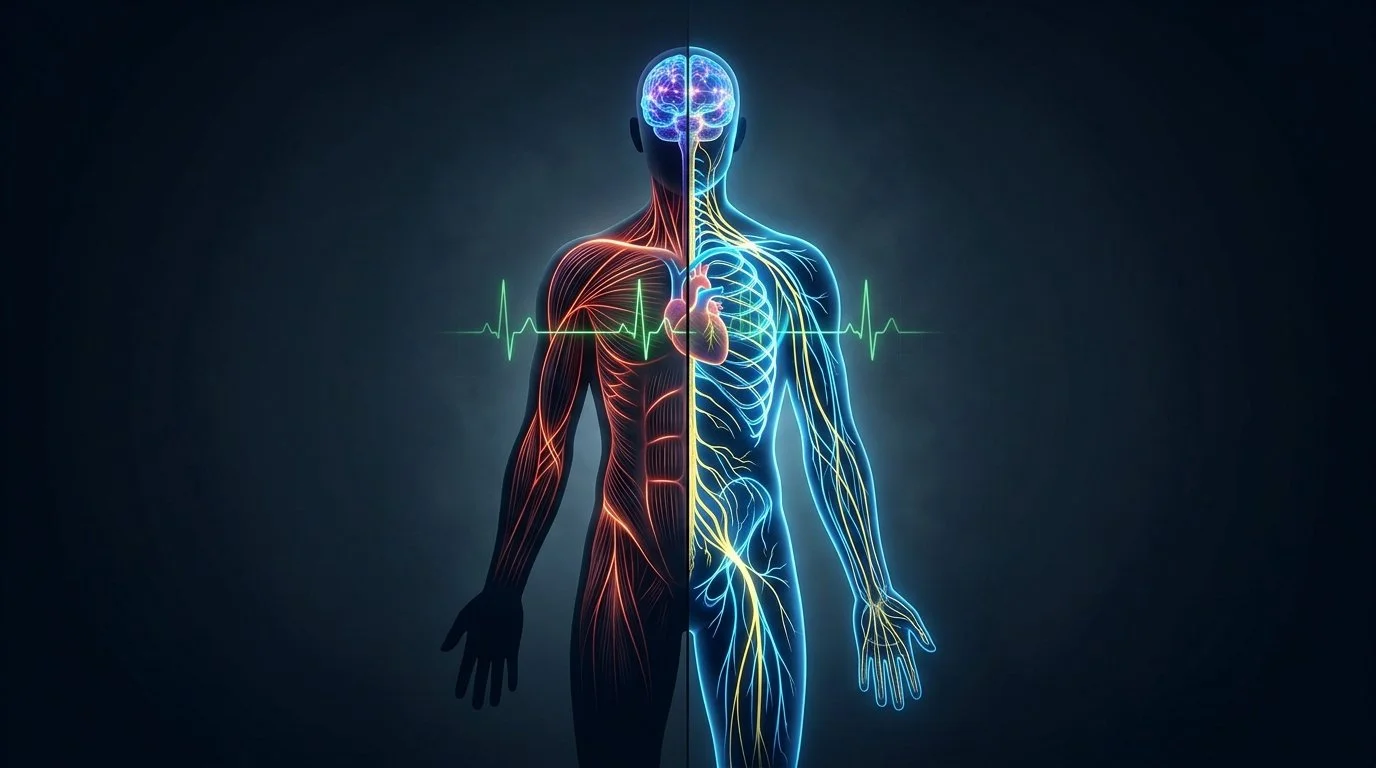
The autonomic nervous system — specifically the ongoing dynamic between sympathetic activation and parasympathetic restoration — is the most concrete site of mind-body integration. In people living with chronic stress, anxiety, trauma, or depression, this system has been dysregulated, typically in the direction of persistent sympathetic dominance: a state of low-level biological emergency that the body was not designed to sustain indefinitely.
The consequences of this dysregulation extend well beyond emotional discomfort. Sustained cortisol elevation suppresses immune function, disrupts sleep architecture, impairs memory consolidation, reduces cognitive flexibility, and accelerates cellular ageing. The body is paying a continuous biological cost for a psychological state. And that cost cannot be reduced by changing your thoughts about it.
Clinical Hypnotherapy directly addresses this. The hypnotic state — a deeply relaxed, inwardly focused state of heightened awareness — produces measurable shifts in nervous system activity. Neuroimaging studies confirm reduced sympathetic activation, increased parasympathetic tone, and changes in brain wave activity from beta to alpha and theta ranges during hypnosis. This is not relaxation as a pleasant side effect. It is therapeutic access to the neurological system where patterns are stored, maintained, and — when the right work is done — genuinely changed.
The Three Pillars: Clinical Hypnotherapy, NLP, and Well-Being Coaching
The integrated approach at Natural and Alive is built on three distinct but deeply interconnected pillars. Each addresses a specific level of the person. Each is amplified by the others. Together, they create a depth and completeness of transformation that no single approach can achieve alone.
Clinical Hypnotherapy
Works directly at the subconscious level — dissolving ingrained patterns, limiting beliefs, and conditioned responses that no amount of conscious effort can reach.
+
NLP — Neuro-Linguistic Programming
Rewires the specific internal trigger-response architecture that keeps stress, anxiety, and limitation alive in daily thought and behaviour.
+
Well-Being Coaching
Translates inner transformation into a forward-moving life — practical tools, daily structures, self-regulation practices, and the sense of purpose that sustains lasting change.
Clinical Hypnotherapy: Reaching the Subconscious Root
Lalitha holds an ICCH Diploma in Clinical Hypnotherapy, accredited by the General Hypnotherapy Standards Council and the International Alliance of Professional Complementary Practitioners, with advanced training under Dr. Paul McKenna — one of the most credentialed and widely respected clinical hypnotherapists in the world. This is the clinical foundation of everything she does.
Clinical Hypnotherapy works by guiding the client into a deeply relaxed, focused state — what the website accurately describes as 'attention with intention.' In this state, the critical faculty of the conscious mind becomes temporarily quieter, and the subconscious becomes genuinely accessible. This is not a trance in any theatrical sense. Clients remain aware, in control, and capable of ending the session at any moment. What changes is the relationship between the conscious and subconscious parts of the mind — the subconscious becomes receptive in a way that ordinary waking awareness does not allow.
In this state, the patterns that maintain stress, anxiety, low self-worth, phobic responses, addictive behaviour, and unprocessed emotional experience can be directly addressed — through guided visualisation, metaphor, therapeutic suggestion, and the installation of new, more functional responses. Crucially, this work does not require the client to relive painful experiences at their full intensity. As the Natural and Alive website states: change is possible 'without revisiting or reigniting past difficult times.' The healing happens in a protected, gently paced inner space.
The clinical evidence for hypnotherapy:
A 2022 meta-analysis in the International Journal of Clinical and Experimental Hypnosis, reviewing 68 randomised controlled trials, found hypnotherapy produced clinically significant outcomes for anxiety, depression, PTSD, chronic pain, and stress-related disorders — with effect sizes comparable to or exceeding CBT for the same presentations. Stanford neuroimaging research by Dr. David Spiegel identified three distinct neural mechanisms active during hypnosis: reduced conflict-monitoring (critical faculty), enhanced mind-body connection, and reduced self-referential rumination. These are precisely the neurological conditions required for subconscious pattern change.
NLP: Rewiring the Trigger-Response Architecture
Neuro-Linguistic Programming was developed by Dr. Richard Bandler and John Grinder in the 1970s through the systematic study of how the most effective therapists of the era — Milton Erickson, Virginia Satir, and Fritz Perls — achieved rapid, lasting change in their clients. What they discovered was that psychological experience has a specific internal structure — a precise architecture of mental images, internal voices, physical sensations, and language patterns — and that this structure can be identified and deliberately changed.
Lalitha trained directly in the lineage of Dr. Richard Bandler — the founder of NLP himself — giving her access to the most advanced and precise NLP techniques available. She uses these not as motivational exercises but as clinical tools for changing the specific internal representations that maintain limiting patterns in daily life.
Where clinical hypnotherapy reaches the deepest subconscious root of a pattern, NLP rewires its daily expression — the specific trigger-response sequences that fire automatically in real-world situations. A person whose anxiety is triggered by professional criticism, or whose anger fires in specific relational patterns, or whose confidence collapses in particular contexts: NLP addresses the precise internal architecture of that trigger, changing it at the level of representation rather than the level of reasoning. The change is typically rapid, because NLP is not asking the conscious mind to learn a different response — it is installing the new response directly.
The combination of hypnotherapy and NLP is significantly more powerful than either alone. Hypnotherapy creates the depth of subconscious access that allows NLP's precision to work at the level where patterns are actually encoded — rather than at the surface level where they merely express themselves.
What Integrated Mind-Body Healing Looks Like in a Session
The philosophy is compelling. The question that matters practically is what it actually looks and feels like — and what it produces.
The Complimentary Consultation
Every journey at Natural and Alive begins with a free, private consultation. This is not an intake form or a sales conversation. It is a genuine clinical exchange — Lalitha listening carefully to understand the specific patterns, history, previous approaches, and goals that are unique to this person. Clients also experience a brief progressive relaxation practice during the consultation — a preview of the hypnotic state that allows them to feel its character before committing to the work.
Together, Lalitha and the client design a personalised plan. This personalisation is not cosmetic. It is therapeutically essential. The subconscious is an individual system — shaped by a specific life history, using a specific internal representational language. A generic protocol reaches a generic subconscious. The personalised approach at Natural and Alive reaches yours.
The Sessions: All Three Levels, Simultaneously
Lalitha's sessions — typically three to five for most presentations — do not follow a linear structure in which hypnotherapy happens first, then NLP, then coaching. The three pillars are woven together within each session, with the specific weighting of each determined by what the client needs in that moment.
A session typically opens with a brief coaching conversation — understanding what has shifted, what has surfaced, what the session needs to address. This conscious-level material seeds the hypnotherapy: Lalitha uses what emerges in the conversation to guide the subconscious work precisely. In the hypnotic state, the specific patterns identified consciously are addressed directly — through personalised guided visualisation, metaphor, and NLP techniques applied at the subconscious level.
The session closes with the installation of practical tools — the 7-11 breathing technique, self-hypnosis anchors, progressive relaxation practices, NLP pattern interrupts — and a coaching conversation about how the inner shift translates into the days ahead. Clients leave with something concrete: not just a felt change, but the tools to sustain and deepen it.
Most concerns are addressed within three to five sessions. This is not because the work is superficial. It is because working directly at the subconscious level — where the patterns actually live — produces change that reverberates upward through every layer of experience, rather than needing to be rebuilt layer by layer from the conscious mind down.
The Guided Visualisation Dimension
Guided visualisation is central to Lalitha's practice — both as a delivery mechanism for hypnotherapy and as a therapeutic tool in its own right. The Natural and Alive website describes its function with precision: 'The subconscious mind learns through imagery, emotion, and repetition. During a session, you are guided to vividly experience responses that may currently feel out of reach — calm instead of anxiety, clarity instead of overwhelm, confidence instead of hesitation.'
The clinical basis for this is neurological. The brain does not fully distinguish between a deeply imagined experience and a real one. When a new response is rehearsed in the relaxed, focused state of hypnosis — when calm is felt viscerally rather than merely understood intellectually — the nervous system begins to encode that response as familiar and available. The change happens experientially first, which is precisely why it translates into behaviour more readily than cognitive reframing alone.
What Integrated Mind-Body Healing Can Address
Because the integrated approach works at the fundamental level of subconscious pattern change and nervous system regulation, it is relevant across a remarkably broad range of presentations. Here are the areas where Lalitha's work produces its most significant results.
Chronic Stress and Anxiety
Stress and anxiety are the most common presentations at Natural and Alive — and the ones for which the integrated approach produces some of its fastest, most complete results. The subconscious threat-detection patterns that generate anxiety are precisely the kind of whole-system phenomenon that requires whole-system work: hypnotherapy to dissolve the root conditioning, NLP to rewire the trigger architecture, and coaching to establish the daily nervous system practices that maintain the new baseline.
Depression and Persistent Low Mood
Depression involves subconscious negative self-referential patterns, neurological dysregulation, disrupted daily rhythms, and a diminished sense of forward possibility — all simultaneously. The integrated approach addresses each of these dimensions in a single coherent framework, making it particularly valuable for people whose depression has resisted approaches that work at only one of these levels.
Confidence, Self-Worth, and Identity
Low confidence and poor self-worth are rooted in subconscious beliefs formed before the conscious mind had any say in them — in the early relational and educational experiences that taught a person what they were worth and what they could expect. These beliefs cannot be argued away or reasoned out of existence. They can be directly changed, at the level where they were formed, through clinical hypnotherapy and NLP. This is one of the most reliable and rapid applications of the integrated approach.
Trauma, Grief, and Unprocessed Experience
Trauma lives in the nervous system and the subconscious — not primarily in narrative memory. The integrated approach reaches it at the level where it is held, dissolving the emotional charge of traumatic experience without requiring the client to relive it at full intensity. The Well-Being Coaching dimension then rebuilds the daily sense of safety, identity, and forward possibility that unprocessed trauma and grief so reliably erode.
Physical Symptoms with Psychological Dimensions
Chronic pain, insomnia, teeth grinding, digestive disturbance, and tension-related physical symptoms are areas where the mind-body interface is particularly evident and where the integrated approach consistently produces results that purely physical treatment cannot achieve alone. HypnoBirthing — Lalitha's work supporting expectant parents through fear-free, calm birth experiences — is one of the most compelling expressions of this: using integrated mind-body work to completely reframe the body's experience of one of its most primal processes.
Why This Matters Now
In the post-pandemic period, something has shifted in how people relate to their mental and emotional health. The old tolerance for years of slow-moving therapy, for managing symptoms rather than resolving them, for understanding problems without actually changing them — that tolerance is diminishing. People are asking for more. They are asking for approaches that work at depth, that work efficiently, and that produce the kind of genuine inner change that translates into a different quality of daily life.
The GTA and Mississauga context makes this particularly acute. The specific pressures of urban Canadian life — financial stress, professional competition, the weight of long commutes and demanding schedules, the particular isolation that can develop within dense, diverse, fast-moving cities — create a population carrying a level of chronic load that surface-level wellness approaches struggle to adequately address.
The efficiency evidence:
Research from the Samueli Institute (2024) found that integrated mind-body interventions combining subconscious work, neurolinguistic pattern change, and lifestyle coaching produced clinically equivalent outcomes to standard single-modality approaches in approximately 40 percent fewer sessions. For clients, this means faster results, lower overall cost, and a return to full functioning that single-modality approaches cannot reliably match on the same timeline. At Natural and Alive, most concerns are addressed within three to five sessions — a promise grounded in the inherent efficiency of subconscious-level work.
This is not about replacing conventional mental healthcare. It is about offering a genuinely integrated, subconscious-level option for the many people whose needs exceed what any single conventional modality can address — and doing so in a context that is warm, personalised, clinically credentialed, and deeply respectful of each person's unique journey.
The Bigger Picture: Healing as Whole-Person Transformation
The goal of Integrated Mind-Body Healing is not the absence of symptoms. Symptoms are the language the system uses when it is out of coherence — and their absence, while welcome, is not the same as genuine wellbeing.
The actual goal is what the Natural and Alive website describes with considerable precision: 'Not just relief from symptoms, but a profound sense of empowerment and transformation that ripples into every area of life.' Clients who complete the work at Natural and Alive are not people who have learned to manage their anxiety more effectively. They are people whose anxiety pattern has fundamentally changed — at the level where it was generated.
They are people whose nervous system has genuinely settled. Whose self-perception has shifted at a level deep enough to change behaviour without effort. Whose daily life has been restructured around the tools and practices that sustain the inner change. Who walk into situations that previously triggered significant distress and find that the distress simply is not there — not because they are suppressing it or managing it, but because the subconscious pattern that was generating it has been replaced with something more functional.
This is what working at every level simultaneously produces. This is what the integration of Clinical Hypnotherapy, NLP, and Well-Being Coaching makes possible. And this is what Lalitha offers at Natural and Alive in Mississauga — to every client, in every session, from the very first free conversation.
No problem can be solved from the same level of consciousness that created it. -- Albert Einstein. This is not a philosophical statement. It is a clinical prescription. The level where the problem lives is the level where the solution must be applied.
Take the First Step
Natural and Alive is located near Heartland Town Centre in Mississauga, Ontario, with in-person sessions available for local and GTA clients and online sessions for individuals anywhere in Ontario and beyond.
Lalitha brings a combination of credentials that is genuinely rare in the Ontario wellness landscape: ICCH Diploma in Clinical Hypnotherapy trained by Dr. Paul McKenna, Licensed NLP Practitioner trained in the lineage of Dr. Richard Bandler, Chopra-certified Well-Being Coach, Ayurveda Teacher, and Primordial Sound Meditation Teacher. Every element of this training serves the integrated approach — ensuring that the whole-system work is grounded in both the best of contemporary clinical science and the accumulated wisdom of the ancient mind-body traditions.
The complimentary initial consultation is available to all new clients. It is a private, unhurried, no-commitment conversation — designed to understand your specific experience, your history with other approaches, and what addressing the root rather than the surface could look like for you. Most concerns are resolved within three to five sessions.